Benefits of Competitor Analysis in Link Building
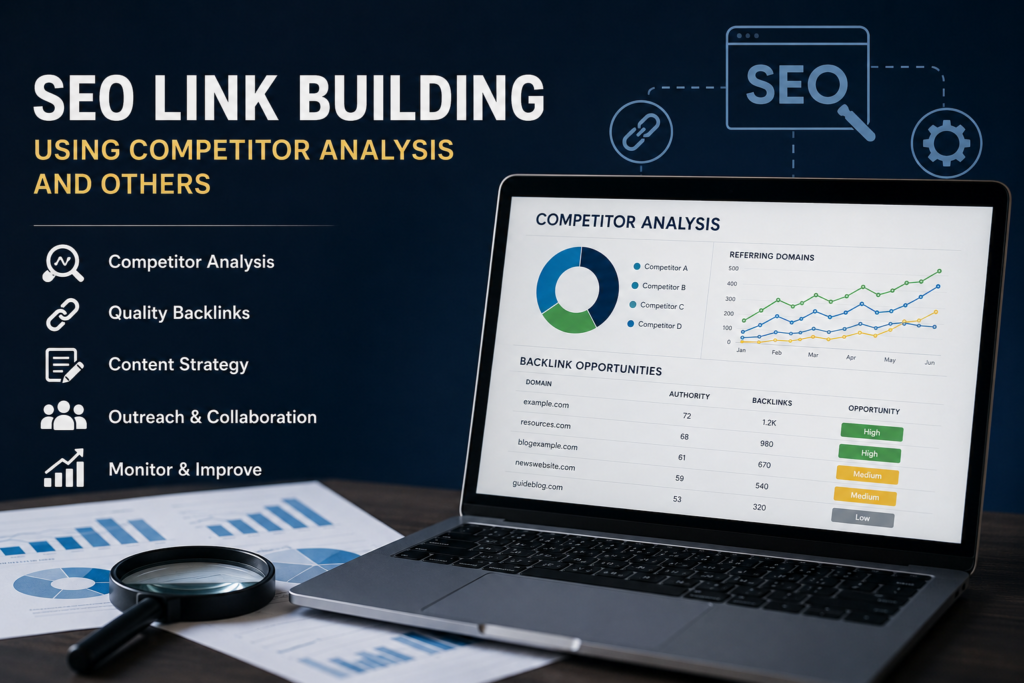
1. Identifies Proven Link Opportunities
If a website links to multiple competitors, there is a higher probability they may also link to your content.
These websites are already interested in the topic or industry, making outreach more targeted and efficient.
2. Reveals Content Gaps
Competitor analysis helps identify content types that naturally attract backlinks.
Examples include:
- Research studies
- Data-driven articles
- Guides and tutorials
- Infographics
- Industry statistics
- Tools and calculators
This insight helps marketers create more link-worthy content.
3. Saves Time and Resources
Instead of manually searching for websites, competitor analysis provides a ready-made database of potential backlink opportunities.
4. Improves Outreach Success Rates
Knowing how competitors acquired links allows SEO teams to personalize outreach based on existing patterns.
How to Perform Competitor Backlink Analysis
Step 1: Identify SEO Competitors
SEO competitors are not always direct business competitors.
They are websites ranking for the same keywords and topics.
Use tools such as:
- Ahrefs
- Semrush
- Moz
- SE Ranking
- Ubersuggest
Search your primary keywords and identify domains consistently appearing on the first page.
Step 2: Analyze Competitor Backlink Profiles
Using SEO tools, review:
- Referring domains
- Domain authority
- Anchor text distribution
- Linked pages
- Link growth trends
- Dofollow vs nofollow ratios
Focus on high-quality referring domains rather than total backlink numbers.
Step 3: Categorize Link Types
Organize competitor backlinks into categories such as:
- Guest posts
- Resource pages
- Editorial mentions
- Business directories
- Niche blogs
- Local citations
- PR features
- Forum discussions
- Podcasts
- Scholarship links
This helps identify scalable link-building strategies.
Step 4: Prioritize High-Value Opportunities
Not every backlink is worth pursuing.
Prioritize opportunities based on:
- Relevance
- Authority
- Organic traffic
- Editorial quality
- Link placement
- Outreach feasibility
Step 5: Create Better Content
If competitors earn backlinks through useful content, improve upon it.
This strategy is commonly called the “Skyscraper Technique,” popularized by Backlinko.
Create content that is:
- More comprehensive
- Better designed
- More updated
- More data-driven
- Easier to read
- More actionable
Effective Link Building Strategies Beyond Competitor Analysis
Competitor analysis is powerful, but combining it with additional strategies creates stronger long-term SEO performance.
1. Guest Posting
Guest posting involves writing articles for external websites in exchange for brand exposure and backlinks.
Effective guest posting focuses on:
- Relevant industry sites
- High editorial standards
- Valuable and original content
- Natural contextual links
Avoid mass guest posting solely for SEO manipulation.
Google has warned against low-quality guest posting campaigns designed only to pass PageRank.
2. Digital PR
Digital PR combines public relations with SEO.
Brands create newsworthy campaigns, surveys, or reports that attract media coverage and backlinks.
Examples include:
- Industry studies
- Market research
- Trend reports
- Interactive tools
- Unique datasets
This strategy often earns links from authoritative news websites.
3. Resource Page Link Building
Many websites maintain curated resource pages.
If your content provides value, you can request inclusion.
Examples:
- Educational resources
- Industry tool lists
- Helpful guides
- Community recommendations
4. Broken Link Building
This strategy identifies broken outbound links on websites and suggests your content as a replacement.
Benefits include:
- Helping website owners fix errors
- Providing relevant replacement content
- Building relationships naturally
Tools like Ahrefs and Check My Links help identify broken links.
5. HARO and Journalist Outreach
Platforms connecting journalists with experts can generate high-authority backlinks.
Providing expert insights to reporters may result in mentions from:
- News organizations
- Business publications
- Industry websites
6. Linkable Assets
Some content naturally attracts backlinks over time.
Examples include:
- Statistics pages
- Original research
- Free tools
- Templates
- Industry reports
- Comprehensive guides
- Case studies
High-value assets often earn passive backlinks without aggressive outreach.
Important Metrics in Link Building
Domain Authority and Domain Rating
Metrics developed by tools like Moz and Ahrefs estimate the strength of a domain’s backlink profile.
While these are not official Google metrics, they help evaluate relative authority.
Referring Domains
A diverse backlink profile from many unique websites is generally stronger than many links from the same domain.
Organic Traffic
Websites with real organic traffic tend to provide more valuable links.
Relevance
Topical relevance is critical.
A backlink from a highly relevant niche site often carries more SEO value than a generic high-authority site.
Anchor Text
Anchor text should appear natural and diverse.
Over-optimized exact-match anchor text can appear manipulative.
Common Link Building Mistakes
Buying Spammy Links
Low-quality paid links from private blog networks or spam sites can trigger penalties.
Google’s spam policies discourage manipulative link schemes.
Ignoring Relevance
Irrelevant backlinks provide limited SEO value and may weaken link profile quality.
Overusing Exact Match Anchors
Aggressive anchor text optimization can create unnatural patterns.
Focusing Only on Quantity
A few strong backlinks often outperform hundreds of weak links.
Neglecting Content Quality
Without valuable content, link building becomes significantly harder.
Recommended SEO and Link Building Tools
Ahrefs
Widely used for:
- Backlink analysis
- Competitor research
- Link intersect reports
- Content exploration
Semrush
Useful for:
- Backlink audits
- Outreach management
- Competitor analysis
- Keyword research
Moz
Known for:
- Domain Authority metrics
- Link Explorer
- SEO monitoring
Google Search Console
Provides direct insights from Google, including:
- Top linking sites
- Internal links
- Indexed pages
- Search performance
Screaming Frog
Useful for technical audits and identifying broken links.
The Role of Content in Link Building
Content remains the foundation of sustainable link acquisition.
Even the best outreach strategy struggles without valuable content.
High-performing content usually demonstrates:
- Expertise
- Originality
- Practical value
- Data accuracy
- Strong formatting
- Clear readability
Google’s emphasis on E-E-A-T (Experience, Expertise, Authoritativeness, and Trustworthiness) reinforces the importance of credible and useful content.
Ethical and Sustainable Link Building
Modern SEO requires a long-term perspective.
Sustainable link building focuses on:
- Real relationships
- Helpful content
- Editorial integrity
- Industry relevance
- User value
Conclusion
Competitor analysis is one of the most effective and data-driven strategies in modern SEO link building. By analyzing where competitors earn their backlinks, businesses can uncover proven opportunities, improve outreach campaigns, and create content that naturally attracts high-quality links.
However, successful link building goes beyond simply copying competitor backlinks. Sustainable SEO growth requires a combination of strong content, strategic outreach, digital PR, relationship building, and ethical SEO practices. Techniques such as guest posting, broken link building, resource page outreach, and creating linkable assets all contribute to building a strong and natural backlink profile.
At the same time, SEO professionals must focus on quality over quantity. Relevance, authority, organic traffic, and editorial value are far more important than acquiring large numbers of low-quality links. Google continues to prioritize trustworthy and user-focused websites, making ethical link building essential for long-term success.
Tools like Ahrefs, Semrush, Moz, and Google Search Console provide valuable insights that help marketers make informed SEO decisions and refine their strategies over time.
Ultimately, businesses that invest in valuable content, genuine relationships, and data-driven link-building strategies are more likely to achieve sustainable rankings, stronger online authority, and long-term organic growth in competitive search results.